
Preferred Simplex Frequencies
The simplex frequencies in the following table correspond to both the ARRL Band Plan and the regional (T-MARC) band plan, and should be used for net operations. On a related note, a generic communications plan in ICS-205 format can be accessed using this link.
Please also see the discussion below the chart with suggestions for running a simplex net.
| 6m | 2 m | 1.25 m | 70 cm | |
| 51.50 | 147.405 | 223.420 | 445.925 | |
| 51.52 | 146.415 | 147.420 | 223.440* | 445.950* |
| 51.54 | 146.430 | 147.435 | 223.460 | 445.975 |
| 51.56 | 146.445* | 147.450 | 223.480 | 446.000** |
| 51.58 | 146.460 | 147.465 | 223.500** | 446.025 |
| 51.60 | 146.475 | 147.480 | 223.520 | 446.050* |
| 52.02 | 146.490 | 147.495 | 446.075 | |
| 52.04 | 146.505 | 147.510 | ||
| 52.525** | 146.520** | 147.525* | ||
| 52.55* | 146.535 | 147.540 | ||
| 53.02 | 146.550 | 147.555 | ||
| 53.51* | 146.565 | 147.570 | ||
| 53.55* | 146.580* | 147.585 | ||
| 53.90 | 146.595 | |||
| * | Montgomery County preferred simplex frequency |
| ** | National Calling Frequencies. These should be used only to establish initial contact or for a brief communication. Choose another simplex frequency for extended operations. |
| *** | 146.400 is listed as a simplex frequency in the ARRL band plan. However, in our area, it is used as a repeater input frequency, and should never be used for simplex communications. |
Simplex Net Operations
Here in Montgomery County, our terrain makes it possible to conduct conduct county-wide nets on a simplex frequency with modest challenges. The county falls mostly within the Piedmont region, although the downcounty area straddles the Atlantic coastal plain boundary. With an attic or roof-mounted antenna, many of us enjoy simplex coverage of a sizable fraction of the county and neighboring jurisdictions.
From an RF perspective, a modest ridge running northeastward from the Shady Grove area eastward is a significant barrier to line-of-sight communications between down- and upcounty home stations having modest antennas. Also noteworthy for their impact on simplex communications are multiple river and stream valleys, including the Potomac River to the west, the Patuxent River to the east, and Rock Creek, Sligo Creek, and the northwest branch of the Anacostia River. Georgia and New Hampshire Avenues follow ridgelines from the Beltway northward, posing barriers to east-west communications. Nevertheless, there are a number of locations close to these high points where stations having roof-mounted antennas have decent coverage of most of the county. Also, we have shown that siting the MCACS van, with its 50-foot pneumatic mast, in Damascus, near the highest point in the county, provides coverage approaching repeater-quality.
There are two important technical issues that should be considered when convening a simplex net. The first is called the hidden transmitter problem. The following illustration shows the coverage area of three stations operating in a simplex net. Stations A and B are both situated within the coverage area of the net control, Station C. However, A and B cannot hear each other. If Station B comes up on frequency while Station A is sending traffic to net control, Station B may assume the frequency is clear and place a call to Net Control, thus interfering with Station A’s ongoing transmission. That’s one common manifestation of the hidden transmitter problem.
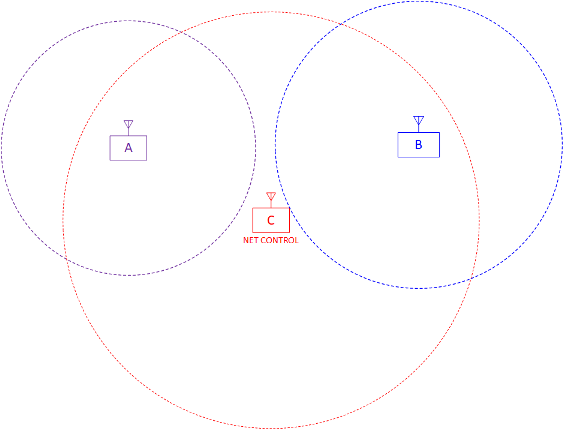
A good way to avoid this is to listen for a reasonable period before transmitting when tuning in to a new channel. Don’t assume the frequency is clear just because you don’t hear anyone. And when you do transmit, keep your initial call short and wait to be acknowledged by Net Control before continuing. That way, if you do interfere with someone else, the interference will be brief.
Resist the temptation to repeatedly call Net Control. If they didn’t hear you the first time, they probably won’t hear the second and third call either. And if they did hear you, they’ll return the call as soon as the ongoing traffic is complete.
So, what is a reasonable amount of time to listen before transmitting on a new channel? If everyone is keeping their transmissions brief, 30 seconds might be sufficient. But if Station A is sending a radiogram, it might take a few minutes to do so. Use your judgment based on the priority of your traffic.
In this situation, if Net Control does hear the call from Station B, they might tell Station B to “Stand by.” Although this prolongs the interference with Station A’s message, it reassures Station B that their call has been heard. It’s really up to Net Control whether to provide this reassurance despite the cost to the ongoing traffic. A corollary is that, whenever Net Control tells one or more stations to “Stand by,” it means that those stations should refrain from any further transmissions until Net Control tells them to go ahead. “Stand by” means that something else is going on that must be completed before any new business can begin. Transmitting after being told to stand by is considered a major infraction in net protocol. The only exception to this is a bona fide time-critical emergency (in which case, the initial call from Station B should have included the procedural word, “Emergency.”).
The other relevant technical issue is called the FM capture effect. In ham jargon, when two stations transmit at the same time, it is called a double. AM and FM receivers perform very differently when a double occurs.
When two AM (or SSB) stations transmit on the same frequency, listeners within range of both stations hear both voices, with the volume of each voice a function of that station’s signal strength at the receiving location. Depending on the relative volume of the two transmitting stations, it may be hard to understand what both stations are saying, but it will be evident that they are both speaking.
With FM, unless the two transmitting stations have roughly the same signal strength at the receiving location, the FM receiver’s demodulation circuit will lock onto the stronger transmission, and the weaker transmission will be completely covered. This can make it difficult for a weak station to ever get a word in edgewise in an ongoing conversation among two or more strong stations. The antidote is simple: everyone needs to leave a pause between transmissions so that weaker stations have the opportunity to break into the conversation.
Incidentally, the FM capture effect is the reason why air traffic communications are still conducted using AM radios. Using AM reduces the likelihood that the air traffic controller will miss a call from an aircraft.
When convening a simplex net, the net control station can use procedures similar to the way we conduct roll calls on our regular weekly nets. That is, net control asks for check-ins by group, with the groups being mobile and handheld stations, base stations operating on emergency power, and then other stations grouped alphabetically by call sign suffix, e.g., A-I, J-R, and S-Z. (Splitting check-ins into small groups like this reduces the chances of a double.)
However, a few things must be done differently in a simplex net.
- First, it is imperative for net control to promptly acknowledge each station who checked in so those stations will not waste time making repeated calls.
- Second, after acknowledging the stations heard in each group of check-ins, net control should ask if there are any relays.
- At the same time, every station in the net — not just net control — should write down, or at least make note of the call signs they heard. This will help to determine which stations in the net are within simplex range of each other. If you hear a station check in who was not recognized by net control, you can assume that they are out of range. When net control calls for relays, you say, “Relay,” followed by your call sign. When recognized by net control, you say, “This is [your call sign]. [Other station’s call sign] is attempting to check in.” Not only have you helped to check that station in, but you will likely be asked to relay any traffic from that station later in the net.
- Following steps 1 through 3 will ensure that every net participant who is able to hear net control will be able to check into the net. But there may be other stations with traffic that are not within earshot of net control. Thus, after completing step 3, net control should ask one or more other stations in advantageous locations to repeat the call for check-ins. You might hear someone refer to these other stations as “alternate net control.”
- Finally, once the net is under way, if you hear traffic on the frequency but cannot hear net control, place a quick call to any other station you heard, telling them you cannot hear net control but wish to check in to the net (or, if you have traffic for the net, say that instead). Then wait a decent interval before repeating, since there may be ongoing traffic that you cannot hear. Trust that anyone who heard you will call you back when there is a break in the traffic.
With a little practice, you will internalize these techniques and they will become second nature.