
Winter Field Day 2026
Winter Field Day lived up to its name this year, at least in the DC area. Winter Field Day (WFD) is an annual nationwide emcomm exercise, always held on the last full weekend in January. Participants — individuals and organizations — are encouraged to set up emcomm stations outdoors and exchange information with other participating stations throughout North America and beyond. The premise of the event is that emergencies don’t always happen when the weather is nice. The event tests participants’ capability to deploy and operate an HF amateur radio station in the field under winter weather conditions.
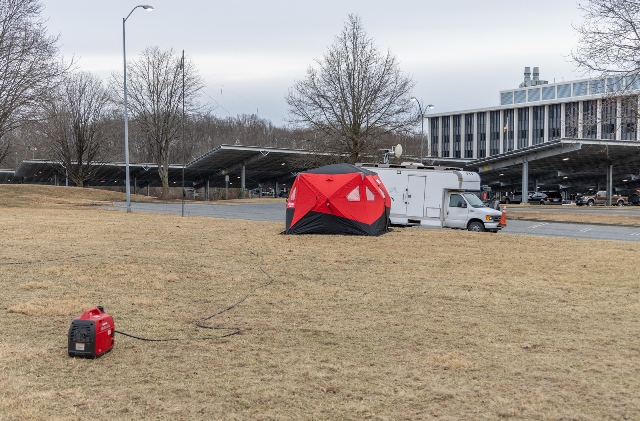
Overall view of the site
Our objectives were to set up two HF stations completely independent of commercial infrastructure and fixed shelter, demonstrate the ability to exchange messages with hams across the U. S, and give our less experienced operators a chance to operate on HF under the mentorship of colleagues. The site this year was a grass field on the grounds of the Montgomery County public safety headquarters building (PSHQ) in Gaithersburg.
Given our mid-Atlantic location, our winter weather is highly variable. Some past WFD weekends have been downright balmy, while others are less so. Last year, for instance, we experienced typical January weather, with an overnight low of 13°F. This year, that was closer to the high temperature for the day, due to a prolonged arctic blast impacting the mid-Atlantic region. With a major snowstorm forecast to reach us at 9 PM on Saturday night, we opted to cut short our event in the interest of safety.
Nevertheless, on Friday afternoon, we set up two HF antennas at our selected site. We chose a terminated folded dipole covering the NVIS bands, and a 20 m dipole for more distant contacts. We deployed them end-to-end in an inverted vee configuration, with the apex of each antenna at 30 feet, using our stock of sectional aluminum masts.
When we reconvened at the site at 10 AM on Saturday to set up our stations, the temperature was 10 °F. We quickly set up our Eskimo brand ice-fishing tent as shelter for one station, while our emcomm van with its built-in IC-718 HF rig was driven to the site to serve as the second station. Both stations were powered by generators, with deep-cycle batteries to provide backup power. As planned, we were ready to begin on-air operations by our target time of 2 PM. Before the beginning of the exercise, K3MRI put out a test call and received a signal report from a station in California.
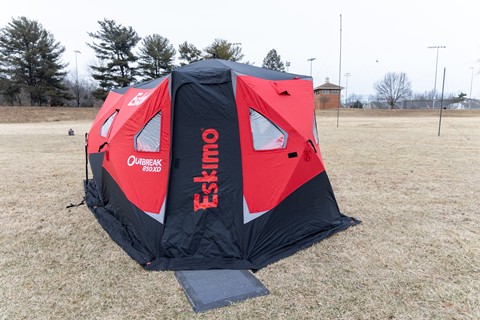
Our cozy tent (designed for ice-fishing)
The bands were quite crowded throughout the exercise period. We often heard five or more stations answering CQs. It often took several tries to be heard by the calling station.
Most contacts were with stations in the eastern two thirds of the U. S., which is to be expected during daytime hours. However, KC3MIX made a contact with a station in Spain on 20 m. That station had the call sign EA6WFD, which is presumably what inspired him to participate in what is primarily a U. S. event! And W3SCI was lucky enough to log a contact with W1AW.
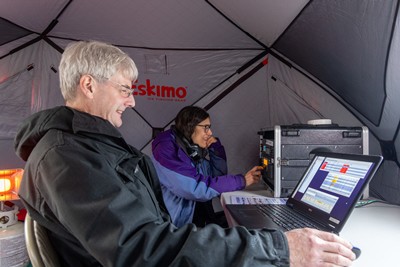
KC3MJV operating, KC3MIX logging on 20 meters
We didn’t make a huge number of contacts, as we emphasized the training aspects of the exercise. But we certainly made enough contacts to demonstrate effective HF communications. And we were please that at least three MCACS members made their first ever HF contacts during the exercise. As old hands know, being able to understand the other operator despite noise and interference is an acquired skill, and it can be intimidating to master the protocols necessary for efficient communications on the HF bands, so making one’s first contact is a big accomplishment.
The new heat pump in the MCACS van did surprisingly well despite temperatures in the teens. (Het pumps in general, and this one in particular, tend to become less efficient when the outside temperature drops below 20.) The new HVAC is MUCH quieter that the ceiling-mounted unit it replaces, results in better distribution of the conditioned air, and uses half the power. Equipped with a soft-start inverter, there is no current surge with the compressor cycles on, which reduces stress on the generator. We supplemented the HVAC with a conventional electric radiator that lives in the van. The combination got the temperature in the van to 63 degrees, which was comfortable enough given the layers of clothing we were wearing. A propane heater kept the tent toasty. (We use carbon monoxide monitors to monitor air quality in both the tent and the van.) However, both the floor of the van and the tent were cold, resulting in cold feet for the operators. In the future, we will try using small fans to better distribute the conditioned air.
With NWS radar showing the snow approaching our location, we shut down the two stations at 5 PM and 6 PM. All the equipment was carefully packed and stowed by 7:30. The MCACS van was returned to the facility where is kept. Everyone was safely home by 9:30, by which time the snow was falling throughout the county.
In all, we made 47 contacts in 18 U. S. states plus Puerto Rico, two Canadian provinces, and one DX entity (Spain). The following map depicts the distribution of the U.S. contacts. The fact that most of the stations were in the eastern half of the country reflects not only propagation conditions, but also the number of exercise participants in each state. This year, severe weather probably kept that number down in several states.
I think it is safe to say that everyone stayed reasonably warm and had fun. Participants included KC3MIX, KC3MJV, KC3MDX, KD3BXL, W3SCI, KD3CFS, K3MRI, W3DCA, KC3YIK, and KN3U. I know I have forgotten a few, so drop me an email and I’ll add you to the list.
Thanks to W3SCI for his photos. You can view additional photos here. And you can download the complete QSO log in Excel format here. Thanks also to Matt Miziorko of OEMHS for making arrangements for us to use the site.
–KN3U